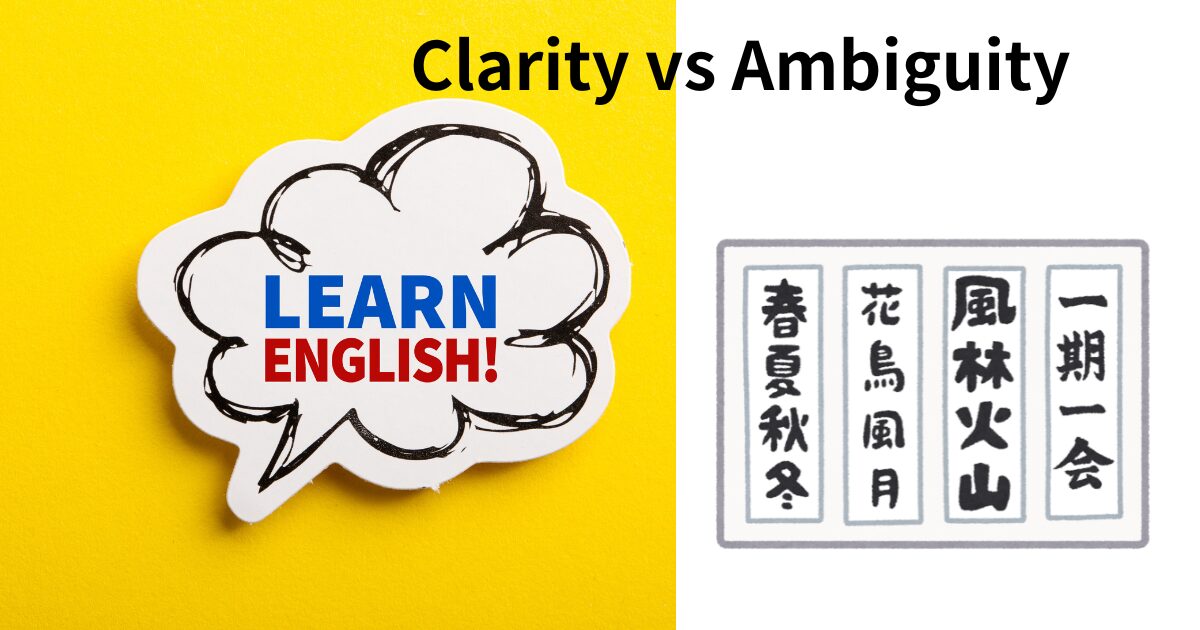
It’s not just the language. It’s the entire social structure behind it.
Living in Japan has taught me many things.
But teaching English here has made one thing painfully clear:
Japanese ambiguity is exhausting.
And I do not mean that only in a linguistic sense.
Yes, the language itself often avoids directness.
Subjects disappear.
Opinions are softened.
Conclusions are delayed.
Everything is wrapped in layers of vagueness.
But the real issue is bigger than grammar.
In Japan, ambiguity is not just a way of speaking.
It is a way of living.
That is what makes it so tiring.
As someone who teaches English, I spend a lot of time helping students express ideas clearly.
What do you think?
Why do you think that?
Can you support your opinion?
Can you say it directly?
These are basic questions in English education.
English, at least in the way it is commonly taught, rewards clarity.
You are expected to have a point.
You are expected to state it.
And ideally, you are expected to support it with reasons.
That structure feels natural to me.
But in Japan, directness is often treated as danger.
People hesitate to say what they really think.
They read the room before they speak.
They soften their opinions before anyone has even challenged them.
Sometimes they avoid having an opinion at all.
The result is a culture where people often speak without truly saying anything.
That may look polite from the outside.
It may even look harmonious.
But in practice, it often creates confusion, frustration, and silent pressure.
Because when nobody speaks clearly, responsibility also becomes unclear.
When everyone tries to preserve the mood, truth becomes secondary.
When “reading the air” matters more than honest communication, the strongest force in the room is not logic, but atmosphere.
And atmosphere is a terrible ruler.
It rewards conformity.
It punishes independence.
It trains people to monitor themselves before anyone else even needs to.
That is one reason I often feel tired in Japan.
The ambiguity is everywhere.
It is in language.
It is in education.
It is in workplaces.
It is in social expectations.
It is in the way disagreement is treated like disruption rather than a normal part of adult life.
In many English-speaking contexts, disagreement does not automatically mean disrespect.
You can disagree and still continue the conversation.
You can say, “I don’t think so,” and the world does not collapse.
That difference matters.
Because when people are allowed to speak clearly, they are also allowed to exist clearly.
They can define themselves, defend their views, and make choices without constantly dissolving into the group.
That is one reason I have always felt more mentally alive in environments shaped by English.
English is not perfect.
No language is.
And English-speaking societies have their own problems.
But clarity has value.
Directness has value.
Saying what you mean has value.
I think many people underestimate how psychologically draining constant ambiguity can be.
When every sentence is softened, every opinion filtered, and every disagreement treated as risky, daily communication becomes exhausting.
You are no longer just speaking.
You are performing adjustment all the time.
That is not peace.
That is pressure with good manners.
The more I teach English, the more strongly I feel this contrast.
English asks for thought.
Japanese social communication often asks for caution.
English encourages structure.
Japanese social norms often encourage emotional weather-reading.
English says:
Make your point.
Japan often says:
Sense the atmosphere first.
That gap is not small.
It shapes how people think, speak, work, and live.
So when I say I am tired of Japanese ambiguity, I am not making a shallow complaint.
I am describing a deep mismatch between two ways of existing in the world.
One asks for clarity.
The other asks for adjustment.
And after years of teaching English, I know which one gives me more energy.