Sho & Taro’s Crazy Japan Adventures #001
- Welcome to Japan! A Very Strange Penguin Arrives at Haneda Airport
- Meet Sho — Your Japanese Tour Guide
- Meet Taro — The Foreign Penguin Who Loves Japan Too Much
- What’s Inside Taro’s Mysterious Bundle?
- Your First Hour in Japan — What Should You Do?
- Japanese You Should Know #001 — Three Essential Expressions
- Japan Is More Than the Japan You Imagine
- Next Episode — Taro Takes on Tokyo!
Welcome to Japan! A Very Strange Penguin Arrives at Haneda Airport
A Japanese tour guide, a mysterious foreign penguin, and a suitcase full of outdated ideas. What could possibly go wrong?
Welcome to a new travel series for anyone planning to visit Japan!
In this series, we’ll explore Japan through the adventures of two rather unusual penguins.
Along the way, you’ll discover famous places, local food, Japanese customs, and practical Japanese expressions you can actually use during your trip.
But don’t expect an ordinary travel guide.
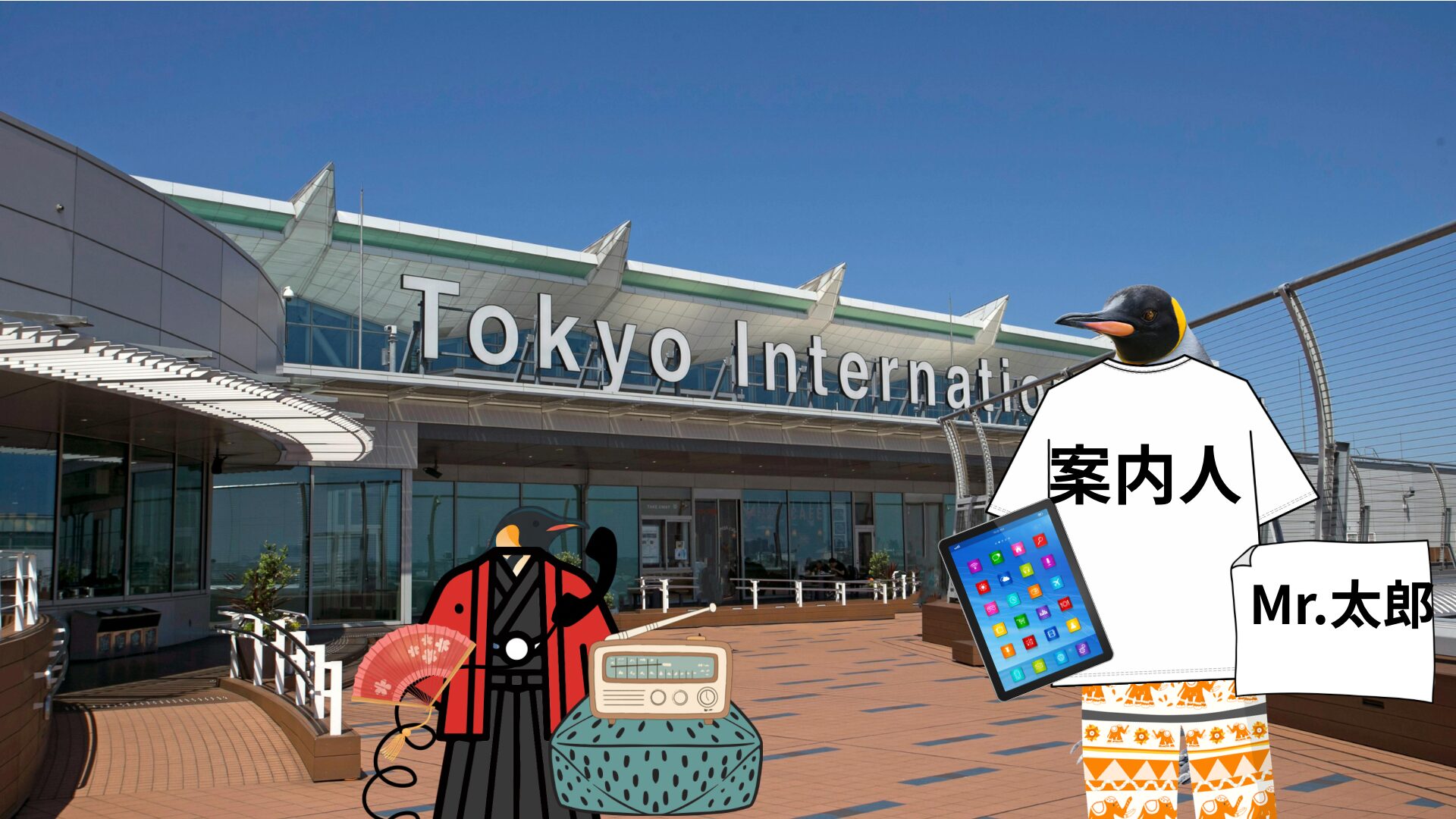
Our first adventure begins at Tokyo International Airport, better known as Haneda Airport.
And trouble is already waiting.
Meet Sho — Your Japanese Tour Guide
Sho is an experienced Japanese tour guide who speaks fluent English.
He knows his way around Japan, understands modern technology, and loves introducing visitors to the country’s hidden charms.
However, Sho has one unusual fashion habit.
He wears colorful Thai elephant pants and a white T-shirt with different Japanese words printed on it.
Today’s T-shirt says:
案内人 (Annainin) — Guide
Sho is waiting outside Haneda Airport with his tablet and a welcome sign.
“Mr. 太郎”
His new customer is a foreign penguin visiting Japan for the first time.
Sho checks his tablet.
“His name is Taro. That’s a rather traditional Japanese name for a foreign visitor.”
Suddenly, someone approaches.
Sho looks up.
And freezes.
Meet Taro — The Foreign Penguin Who Loves Japan Too Much
Standing in front of Sho is a small penguin wearing a traditional Japanese outfit.
A red haori jacket.
Black hakama trousers.
A folding fan.
And a large mysterious bundle wrapped in cloth.
Sho: “Excuse me. Are you Mr. Taro?”
Taro: “YES! I AM TARO! THE MOST JAPANESE FOREIGN PENGUIN IN THE WORLD!”
Sho: “The most Japanese foreign penguin?”
Taro: “Exactly! I have studied Japanese culture for years!”
Sho: “Wonderful! Is this your first visit to Japan?”
Taro: “YES! My dream has finally come true!”
Sho looks at Taro’s traditional clothes.
Sho: “Why are you dressed like that?”
Taro: “Because I’m in JAPAN!”
Sho: “Well, yes, but most Japanese people don’t wear hakama every day.”
Taro: “WHAT?! THEN WHY DID I SPEND THREE MONTHS CHOOSING THIS OUTFIT?!”
Sho realizes that this tour may be more difficult than expected.
And they haven’t even left the airport.
🤣
What’s Inside Taro’s Mysterious Bundle?
Sho notices the large cloth bundle beside Taro.
Sho: “Taro, what’s inside your bag?”
Taro: “Everything I need to survive in modern Japan!”
Taro proudly opens his bundle.
Out comes an old portable radio.
Sho stares at it.
Sho: “A RADIO?!”
Taro: “Of course! I need the latest Japanese information!”
Sho: “You have a smartphone, right?”
Taro: “A what?”
Sho closes his eyes.
This is going to be a very long trip.
Taro: “Don’t worry, Boss Sho! I’ll use my radio to find the airport information channel!”
Sho: “TARO! THE AIRPORT INFORMATION DESK IS NOT A RADIO STATION!”
Taro: “Then how do Japanese people find anything?!”
Sho raises his tablet.
Sho: “Welcome to modern Japan.”
🤣🤣
Japanese Culture Corner: Three Things Taro Brought
Taro’s belongings may look unusual, but they offer a chance to learn about Japanese culture.
1. Hakama (袴)
Traditional Japanese trousers or a skirt-like garment worn over a kimono. Today, hakama are commonly associated with ceremonies, traditional arts, and certain martial arts.
2. Furoshiki (風呂敷)
A traditional Japanese wrapping cloth used to carry or wrap various objects.
Furoshiki are still useful today and can be an environmentally friendly alternative to disposable packaging.
3. Sensu (扇子)
A traditional folding fan.
Unlike Taro’s radio, this is actually quite practical! A folding fan can be especially useful during Japan’s hot and humid summers.
Not everything traditional is outdated.
Sometimes old-fashioned Japanese ideas are surprisingly clever.
Your First Hour in Japan — What Should You Do?
Taro may be confused, but there’s no need for you to be!
If you’re visiting Japan for the first time, here are a few practical things to remember.
Check Your Internet Connection
Before traveling, consider how you’ll use mobile data in Japan.
Depending on your phone and travel plan, you may be able to use an eSIM, a local SIM card, or an international roaming service.
Airport Wi-Fi can also be useful, but don’t assume you’ll have free internet everywhere you go.
And no, Taro’s old radio won’t connect to Google Maps.
Find Your Transportation
Haneda Airport has rail connections to central Tokyo, including the Tokyo Monorail and Keikyu lines.
Which route is best depends on your destination.
Look for official airport signs, check the current route information, and make sure you know the name of your destination station.
If you’re unsure, ask a station employee.
Keep Important Information Accessible
Have your accommodation address, booking confirmation, and essential travel information available.
Keeping a copy that you can access without internet is a sensible precaution.
Sho explains all this to Taro.
Sho: “Do you understand?”
Taro: “Absolutely!”
Sho: “Excellent. Where are we going first?”
Taro: “I don’t know. My paper map is from 1972.”
Sho: “TAROOOO!!!”
🤣
Japanese You Should Know #001 — Three Essential Expressions
Before leaving the airport, let’s learn three Japanese expressions that can help during your trip.
1. すみません — Sumimasen
Meaning: Excuse me.
This is one of the most useful words you’ll learn in Japan.
You can say it when you want someone’s attention, need assistance, or wish to apologize politely.
Example:
“Sumimasen!”
Excuse me!
2. 駅はどこですか? — Eki wa doko desu ka?
Meaning: Where is the station?
Use this when you’re trying to find a railway station.
Combine it with sumimasen to ask politely.
Example:
“Sumimasen. Eki wa doko desu ka?”
Excuse me. Where is the station?
3. ありがとうございます — Arigatō gozaimasu
Meaning: Thank you very much.
This is a polite expression of gratitude.
Use it when someone helps you, gives you directions, or provides a service.
Example:
“Arigatō gozaimasu!”
Thank you very much!
Practice with Sho and Taro!
Sho: “Taro, try asking me where the station is.”
Taro: “SUMIMASEN!”
Sho: “Good!”
Taro: “EKI WA DOKO DESU KA?”
Sho: “Excellent! You’re learning!”
Taro: “ARIGATŌ GOZAIMASU!”
Sho: “Perfect! Now let’s go.”
Taro immediately picks up his enormous bundle.
Taro: “Boss Sho! Should I carry my radio or my fan?”
Sho: “JUST BRING YOURSELF!”
🤣
Japan Is More Than the Japan You Imagine
For many first-time visitors, Japan is a country of fascinating contrasts.
Ancient temples stand alongside modern buildings.
Traditional customs exist beside advanced technology.
You may find quiet residential streets only minutes away from crowded shopping districts.
And the Japan you experience may be quite different from the Japan you imagined before arriving.
That’s what makes traveling interesting.
Sho knows this very well.
Taro, however, is still convinced that everyone in Japan owns a samurai sword and a folding fan.
His education has only just begun.
Fortunately, Sho has plenty of patience.
Well…
At least for now.
Next Episode — Taro Takes on Tokyo!
Our two penguins are finally ready to leave Haneda Airport.
Next, Sho will introduce Taro to Tokyo’s transportation system.
Trains, stations, ticket gates, and useful Japanese expressions.
For first-time visitors, Tokyo can be exciting — and a little confusing.
For Taro?
It could be a complete disaster.
Will Sho get his mysterious customer safely into Tokyo?
Find out in the next episode of Sho & Taro’s Crazy Japan Adventures!
See you in Japan! 🇯🇵🐧🤣