Japan is often described as a safe, clean, and organized country.
Tourists see the trains, the convenience stores, the polite service, and the quiet streets. From the outside, Japan can look like a well-functioning society.
But behind that clean surface, there is a very uncomfortable reality.
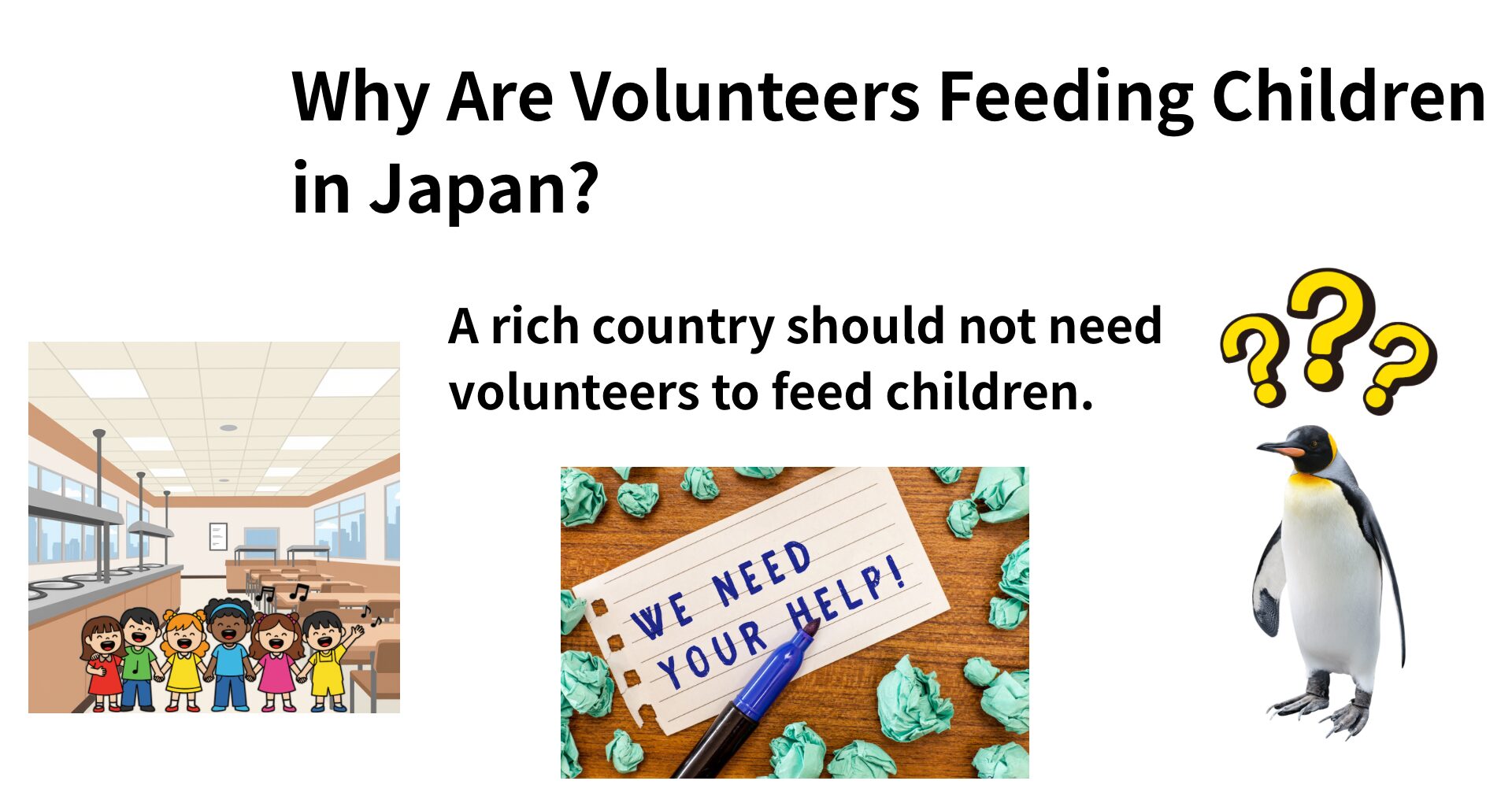
Across Japan, there are now more than 12,000 kodomo shokudo — children’s cafeterias that provide free or low-cost meals to children and families.
At first, this may sound heartwarming.
Local people helping children.
Volunteers cooking meals.
Communities supporting each other.
And yes, the people running these places deserve respect.
But the existence of so many children’s cafeterias should not only make us feel warm.
It should make us angry.
Because this is not happening in a country with no money.
Japan’s tax revenue has been reaching record highs. The government collects huge amounts of money from ordinary people through income tax, consumption tax, social insurance payments, and many other burdens.
People are squeezed from every direction.
Prices go up.
Taxes go up.
Social insurance payments go up.
Real wages do not keep up.
And yet, in the same country, children still need places where volunteers provide meals.
What does that tell us?
It tells us that something is deeply broken.
A children’s cafeteria should not become a replacement for government responsibility.
When private citizens have to step in because the public system is not protecting children properly, that is not a beautiful story. It is a warning sign.
Japan loves beautiful words.
“Community.”
“Support.”
“Connection.”
“Kindness.”
“Everyone helping each other.”
These words sound nice.
But sometimes, beautiful words hide ugly structures.
If people are helping each other because the government has created a fair society, that is wonderful.
But if people are helping each other because the government is failing to do its basic job, then calling it “kindness” is not enough.
It becomes a convenient excuse.
Japan often depends on the patience and goodwill of ordinary people.
Teachers work too much.
Nurses endure too much.
Parents carry too much.
Volunteers fill the gaps.
Local communities patch the holes.
And then the government acts as if the system is working.
But it is not working.
It is being held together by unpaid labor, silent sacrifice, and people who cannot ignore suffering in front of them.
That is not a healthy society.
A wealthy country should not be proud that volunteers are feeding hungry children.
A wealthy country should ask why those children need volunteer-run meals in the first place.
The real issue is not whether children’s cafeterias are good or bad.
They are good.
The problem is that they are necessary.
That necessity exposes the failure of the system.
If Japan can collect record tax revenue, fund large projects, support certain industries, and spend money on countless bureaucratic systems, then it should also be able to make sure children can eat properly without depending on charity.
Children should not have to rely on the kindness of strangers because adults in power refuse to build a fairer society.
Food is not a luxury.
Childhood is not a private problem.
Poverty is not something that should be quietly hidden behind polite smiles and community slogans.
When more and more children’s cafeterias appear across the country, we should not only say, “How kind.”
We should also ask:
Why are there so many?
Why are they increasing?
Why is the government not doing more?
Where is the tax money going?
Why are ordinary people always expected to carry the burden?
Japan is very good at making people endure.
It teaches people to be quiet, polite, patient, and grateful.
But children’s hunger should not be endured.
Family poverty should not be hidden.
And volunteer kindness should not be used as a mask for political failure.
A society is not judged by how clean its train stations are.
It is judged by whether children can eat, live, learn, and grow without being abandoned by the system.
Japan has money.
Japan has tax revenue.
Japan has institutions.
So why are volunteers doing what the government should have made unnecessary?
That is the question Japan does not want to face.