Japan Often Confuses a Small Reward with a Good Investment
In Japan, shareholder perks are extremely popular.
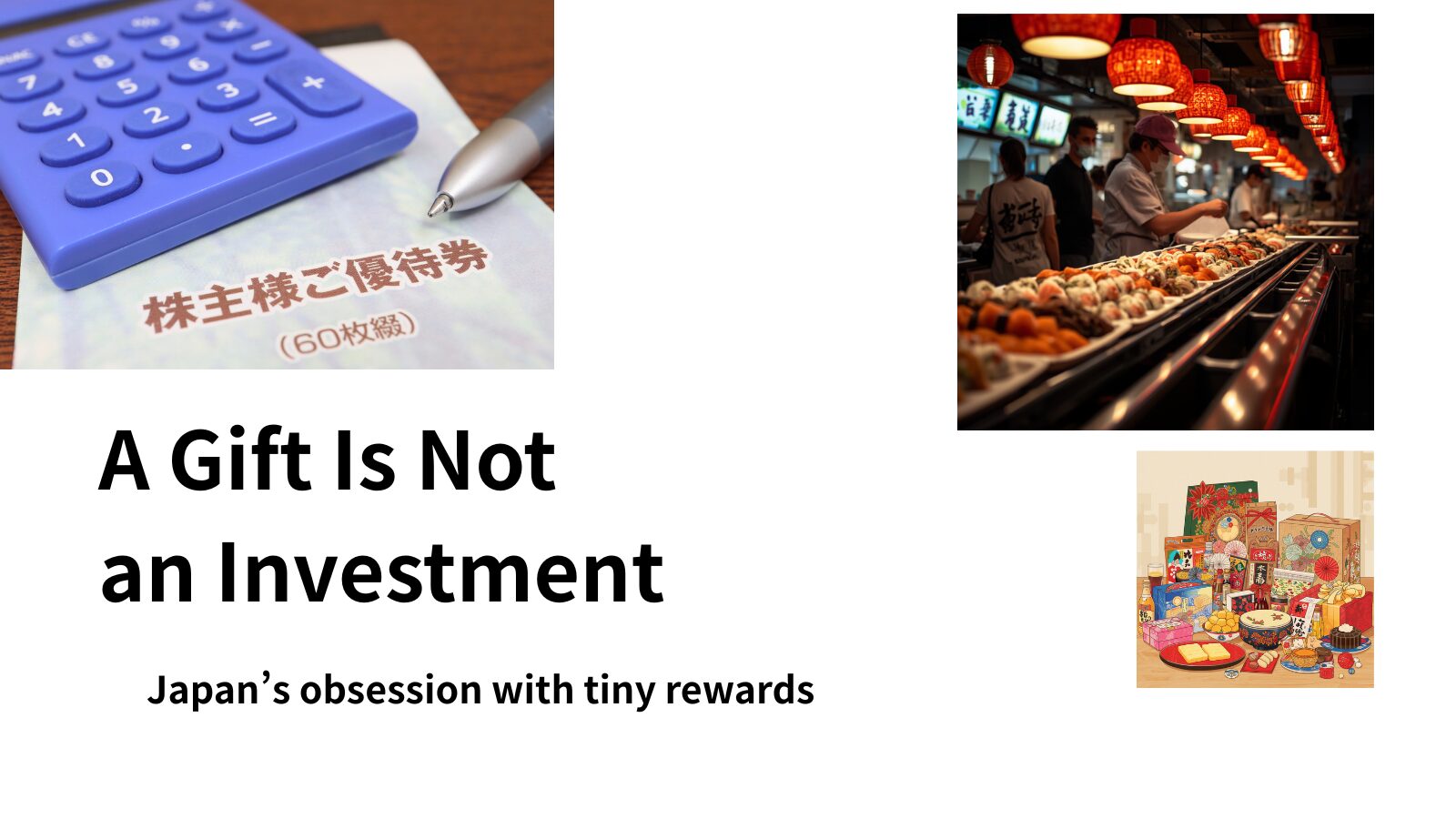
Companies offer meal coupons, discount tickets, product boxes, and other small rewards to individual investors. Many people treat these perks as if they are a major reason to buy stocks.
At first glance, this may look generous.
But from my point of view, it reveals something much deeper.
Japan often confuses a small reward with a good investment.
Some investors are willing to lock up hundreds of thousands of yen just to receive a meal coupon, a box of drinks, or a discount ticket.
But if you want to eat sushi, why not simply pay for sushi?
If you want a box of drinks, why not simply buy the drinks?
Why lock up a large amount of capital, accept stock price risk, and limit your flexibility just to receive a small reward?
This is where I feel Japanese investing culture often becomes backward.
The original purpose of investing should be to grow capital.
But in Japan, many people are distracted by visible rewards. They focus on the gift, not the growth. They look at the coupon, not the capital. They feel satisfied because they received something physical, even if the financial logic is weak.
This is not only about investing.
It reflects a broader cultural pattern.
Japan often values visible, immediate rewards more than invisible long-term value.
A coupon feels real.
A gift box feels real.
A discount ticket feels real.
But opportunity cost is invisible.
Capital efficiency is invisible.
Compounding is invisible.
And because these things are invisible, many people ignore them.
To me, this feels less like investing and more like a gacha machine for adults.
People put a large amount of money into the system, wait for a small reward, and feel happy when something visible comes out.
But the real question is not, “What did I receive?”
The real question is, “How much freedom did I give up to receive it?”
That is why I prefer U.S. stocks.
With U.S. stocks, I do not expect a gift box. I do not need a meal coupon. I do not want a company to send me tea, noodles, or discount tickets.
I want the company to grow.
I want my capital to work.
I want flexibility.
I want long-term freedom.
A small reward may feel nice for a moment.
But if that reward requires locking up hundreds of thousands of yen, taking stock price risk, and losing flexibility, I do not see it as a reward.
I see it as a distraction.
In my view, many Japanese investors are not really investing.
They are shopping for gifts through the stock market.
And that is exactly why I stay away from Japanese stocks.