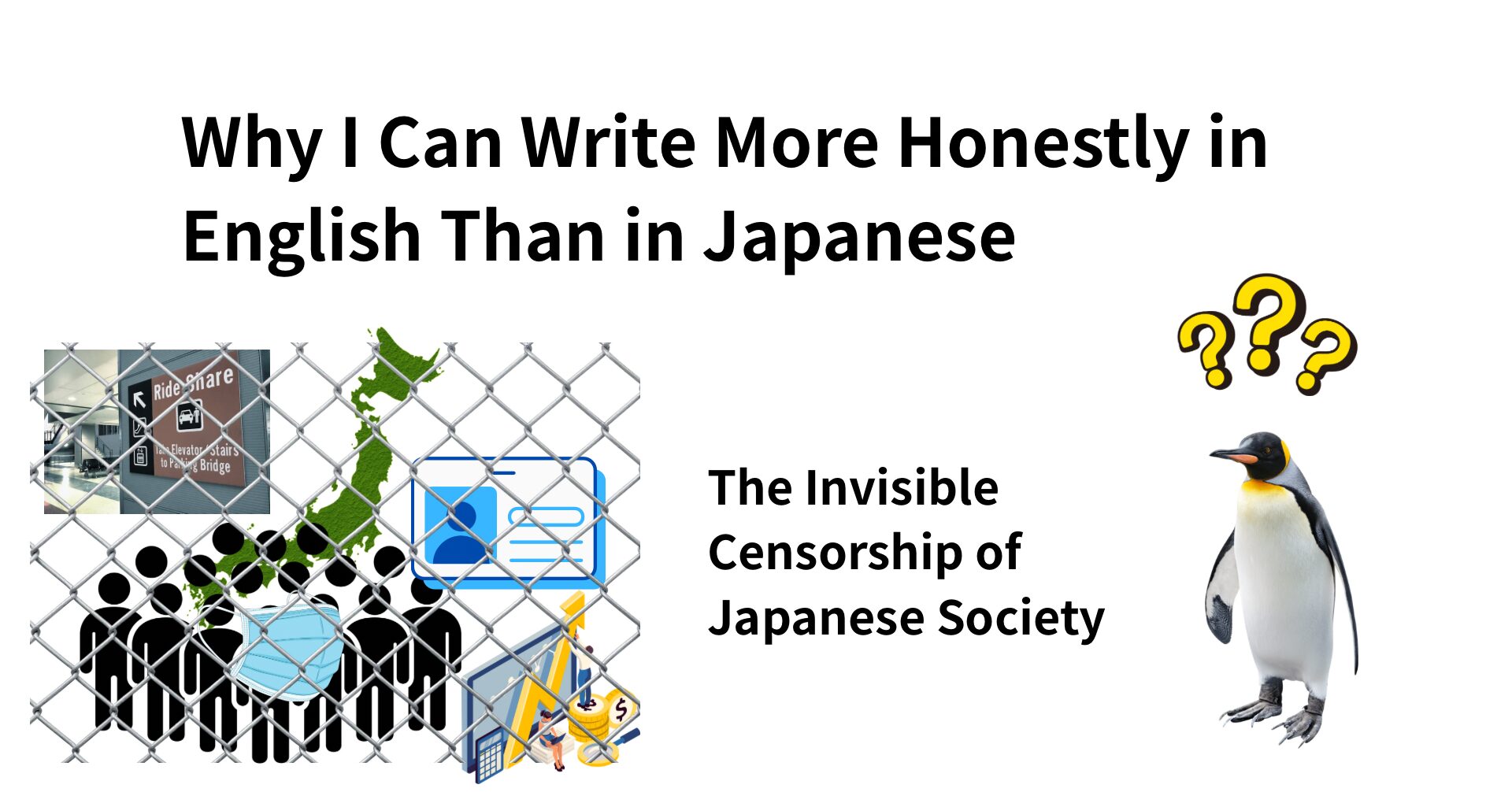
The Invisible Censorship of Japanese Society
Sometimes I feel that my operating system is written in English.
I was born and raised in Japan.
I work in Japan.
I understand Japanese society very well.
And yet, when I speak English in Japan, foreign people often ask me the same question.
“Where are you from?”
This has happened to me many times.
Not once.
Not twice.
Almost ten times.
At first, I found it strange.
I am Japanese.
Why do people ask me where I am from?
But now I think I understand.
Maybe my face is Japanese, but my way of thinking is not always running on the standard Japanese operating system.
When I speak English, I sound more direct.
My thoughts move faster.
My words come out without unnecessary decorations.
I do not feel the need to wrap every sentence in blankets.
But when I try to write the same thing in Japanese, something strange happens.
A safety device turns on.
I did not install it.
I did not ask for it.
I do not even want it.
But somehow, the Japanese social safety device starts working inside my head.
It asks me:
“Is this too direct?”
“Will this offend someone?”
“Will people say I hate Japan?”
“Will people tell me to leave the country?”
“Should I make this softer?”
“Should I add more polite phrases?”
“Should I say that this is only my personal opinion?”
Before I write the truth, I am already forced to think about how to protect other people’s comfort.
That is exhausting.
In Japanese society, air is not something you breathe.
It is something you are expected to read.
You read the room.
You read the group.
You read the silence.
You read the invisible rules.
You read what people do not say.
And if you fail to read the air, people do not simply disagree with you.
They often treat you as a problem.
This is why writing honestly in Japanese can feel so suffocating.
It is not because Japanese is a bad language.
Japanese can be beautiful, delicate, and rich.
The problem is not the language itself.
The problem is the invisible social pressure attached to it.
In Japan, words like harmony, cooperation, bonds, and consideration sound beautiful.
But sometimes, these words are used to make people quiet.
Harmony can mean, “Do not disagree.”
Cooperation can mean, “Do what everyone else does.”
Bonds can mean, “You are not allowed to leave.”
Consideration can mean, “Protect the feelings of the group before your own truth.”
That is not freedom.
That is social control wearing beautiful clothes.
When I write in English, I can say:
“This is wrong.”
“This is not freedom.”
“This is social pressure.”
“This is a system of control.”
But when I write the same thing in Japanese, I feel that I must first cover my words with blankets.
A blanket of politeness.
A blanket of soft expressions.
A blanket of apologies.
A blanket of “of course, there are good sides too.”
A blanket of “this is only my personal experience.”
By the time the sentence is fully covered, the truth is almost dead.
This is the invisible censorship of Japanese society.
Nobody officially bans me from writing.
Nobody stands behind me with a red pen.
Nobody says, “You cannot write this.”
But the censorship is already inside the atmosphere.
It is in the fear of being disliked.
It is in the fear of being called selfish.
It is in the fear of being told, “If you hate Japan so much, why don’t you leave?”
It is in the fear of being treated as someone who disturbs the group.
That is why English gives me freedom.
English gives me distance from Japanese social pressure.
English gives me space to think clearly.
English lets me separate the truth from the atmosphere around it.
When I write in English, I do not have to bow before every sentence.
I do not have to apologize before I speak.
I do not have to pretend that everything has two equal sides when one side is clearly unreasonable.
I can stand on my own feet.
And that is what I want more people to do.
I do not want people to move only because everyone else moves.
I do not want people to obey only because the atmosphere says so.
I do not want people to call pressure “harmony” and silence “peace.”
I want people to think.
I want people to question.
I want people to decide with their own minds.
Maybe that is why my operating system feels English.
English did not simply teach me another language.
It gave me another way to breathe.
In Japan, I am often expected to read the air.
But I do not want to be praised for reading the air.
I want to breathe.