- Tokyo Trains: Taro vs. the Automatic Ticket Gate!
- The First Challenge: Getting Into Tokyo
- Taro Discovers the Automatic Ticket Gate
- Suica, PASMO, and Modern Train Travel
- Tokyo’s Train Network: Don’t Panic!
- Japanese You Should Know #002 — At the Train Station
- The Real Japan Is Waiting Outside
- Next Episode — Welcome to Nagoya!
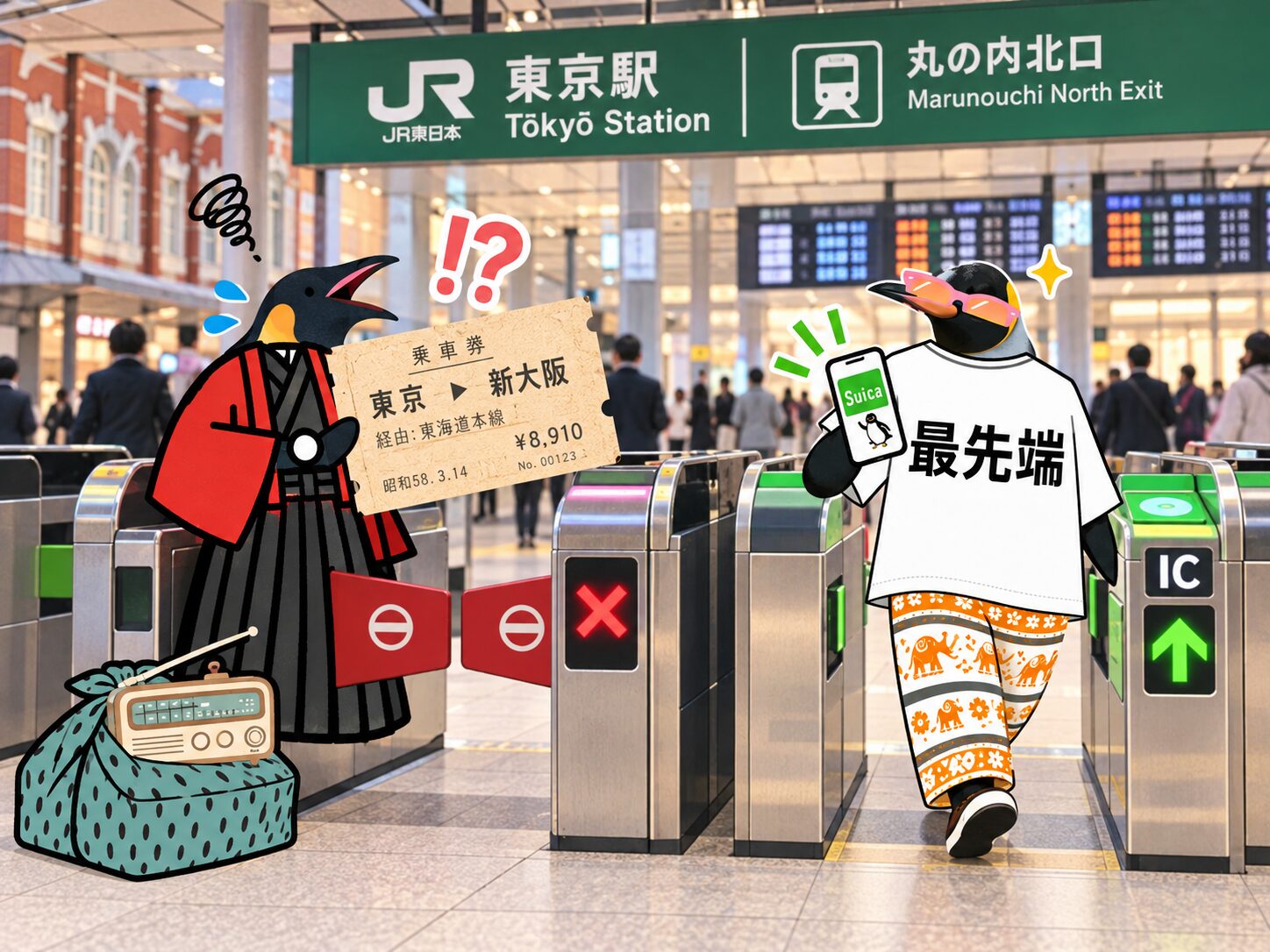
Tokyo Trains: Taro vs. the Automatic Ticket Gate!
One Japanese tour guide. One Japan-obsessed foreign penguin. And one very confused ticket gate.
Welcome back to Sho & Taro’s Crazy Japan Adventures!
In Episode #001, Sho finally met his unusual customer at Haneda Airport.
Sho is a fluent English-speaking Japanese tour guide who knows how to travel around modern Japan.
Taro is a mysterious foreign penguin who loves Japan so much that he gave himself a Japanese name.
He wears traditional Japanese clothing and carries a furoshiki filled with old-fashioned Japanese objects.
Today, our two penguins are heading into central Tokyo.
Their destination is Tokyo Station.
There is just one problem.
Taro thinks Japan’s railway system still works like it did decades ago.
🤣
The First Challenge: Getting Into Tokyo
Sho opens his tablet.
Sho: “All right, Taro! Let’s go to Tokyo Station.”
Taro: “Wonderful, Boss Sho! Where is our horse?”
Sho: “Our WHAT?!”
Taro: “A horse! We’re traveling to the capital, aren’t we?”
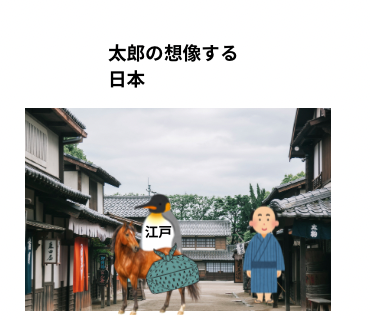
Sho: “Taro, this isn’t the Edo period! We’re taking a train!”
Sho explains that there are several ways to travel from Haneda Airport into Tokyo.
For example, travelers can take the Tokyo Monorail to Hamamatsucho Station and transfer to a JR train.
Another option is the Keikyu Line, which connects Haneda Airport with Shinagawa and other destinations.
The best route depends on where you’re going.
Sho: “Today, we’ll take the monorail and change trains at Hamamatsucho.”
Taro: “Change trains?”
Sho: “Yes. It’s called a transfer.”
Taro: “Why don’t we just change horses?”
Sho: “TAROOOO!!” 💢
Taro Discovers the Automatic Ticket Gate
They arrive at the station entrance.
Taro stops walking.
In front of him is an automatic ticket gate.
Taro: “Boss Sho! Where is the station employee?”
Sho: “Why?”
Taro: “Someone must punch my ticket!”
Sho looks confused.
Taro proudly opens his furoshiki.
Out comes an old metal ticket punch.
Sho: “WHAT IS THAT?!”
Taro: “A traditional Japanese railway tool! I’ve studied everything!”
Sho: “You brought a ticket punch from overseas?!”
Taro: “Of course! I want to experience REAL Japanese culture!”
Taro produces a homemade cardboard ticket.
He punches a hole in it.
CLICK!
Taro: “DONE! NOW I CAN ENTER!”
He proudly approaches the automatic gate.
Nothing happens.
Taro: “BOSS SHO! THE GATE IS BROKEN!”
Sho: “NO, TARO! YOUR TICKET ISN’T VALID!”
🤣🤣
Japanese Culture Corner: The Ticket Punch
In the past, railway employees in Japan manually checked and punched passengers’ tickets.
These metal tools were known as 改札鋏 (kaisatsu-basami) — ticket punches used at station gates.
Today, automatic ticket gates are common in major Japanese cities.
But paper tickets haven’t disappeared. They can still be used at compatible ticket gates.
Old technology is part of Japan’s history. It doesn’t mean it’s the way modern transport works.
Unfortunately, Taro has brought the history museum with him.
🤣
Suica, PASMO, and Modern Train Travel
Sho shows Taro a transportation IC card.
Sho: “Look, Taro. This is a rechargeable transportation card.”
Taro: “A card? No punching?”
Sho: “No punching.”
Taro: “No scissors?”
Sho: “No scissors!”
Taro: “THEN HOW DO THEY KNOW I’M HONEST?!”
Sho: “THE COMPUTER CHECKS YOUR CARD!!”
Sho explains that Suica and PASMO are commonly used transportation IC cards.
On participating trains and buses, passengers can use a charged card to pay their fare.
At a compatible automatic gate, simply tap the card on the reader when entering and leaving.
Many visitors find this easier than buying a separate ticket for every journey.
However, not every train or transportation service accepts the same payment methods, so it’s worth checking before traveling.
Sho: “See? Modern Japan is convenient!”
Taro: “Amazing!”
Taro looks at his metal ticket punch.
Taro: “But can I keep this?”
Sho: “Of course. Just don’t try to use it on the ticket gate!”
Tokyo’s Train Network: Don’t Panic!
Tokyo has an extensive transportation network.
You’ll encounter several operators, including JR, Tokyo Metro, Toei Subway, and private railway companies.
The network can look confusing at first.
But don’t worry.
Here are three useful habits.
1. Know your destination station.
Tokyo is a huge city. Before traveling, check the name of the station nearest your hotel or destination.
2. Check the train line and direction.
Look at station signs, platform numbers, and the train’s destination.
The right railway line isn’t enough. You also need to travel in the correct direction.
3. Ask for help when you’re unsure.
Many major Tokyo stations have English-language signs, and station staff can help with directions.
You don’t need perfect Japanese to ask a simple question.
Sho looks at Taro.
Sho: “Do you understand?”
Taro: “YES!”
Sho: “Good. Where are we going?”
Taro: “TOKYO!”
Sho: “Which station?”
Taro: “JAPAN STATION!”
Sho: “THERE IS NO STATION CALLED JAPAN STATION!!” 💢
🤣🤣🤣
Japanese You Should Know #002 — At the Train Station
Let’s learn three useful expressions for traveling around Japan.
1. この電車は東京駅に行きますか?
Kono densha wa Tōkyō-eki ni ikimasu ka?
Does this train go to Tokyo Station?
Use this to confirm that you’re boarding the correct train.
2. ここで乗り換えですか?
Koko de norikae desu ka?
Do I transfer here?
Use this when you’re unsure whether you’ve reached your transfer station.
乗り換え (norikae) means transfer.
3. 切符はどこで買えますか?
Kippu wa doko de kaemasu ka?
Where can I buy a ticket?
Use this if you need a paper ticket or want to find the ticket machines.
Remember: すみません (sumimasen) — Excuse me — is a useful way to begin your question.
Practice with Sho and Taro!
Sho: “Taro, ask me if this train goes to Tokyo Station.”
Taro: “KONO DENSHA WA TŌKYŌ-EKI NI IKIMASU KA?”
Sho: “Excellent!”
Taro: “KOKO DE NORIKAE DESU KA?”
Sho: “Very good! You’re learning!”
Taro reaches into his furoshiki again.
Sho: “What are you doing now?”
Taro: “I’m getting my ticket punch ready for the next station!”
Sho: “PUT THAT THING AWAY!!”
🤣
The Real Japan Is Waiting Outside
Japan is famous for combining traditional culture with modern technology.
But the reality is more interesting than a simple comparison between old and new.
Some traditional tools are still useful.
Others have become part of history.
And modern systems can be surprisingly easy to use once you understand how they work.
That’s what Sho wants Taro to discover.
You don’t have to copy everything you imagine Japanese people do.
You can learn about the country, experience its culture, and make your own choices.
Sho finally gets Taro onto the correct train.
For the first time, the mysterious foreign penguin is traveling through Tokyo’s modern railway network.
The doors close.
Sho smiles.
Perhaps things will finally go smoothly.
Then Taro whispers:
“Boss Sho… do you think the train driver would like to borrow my ticket punch?”
“TAROOOOOO!!!” 💢
🤣🤣🤣
Next Episode — Welcome to Nagoya!
Our two penguins have survived their first railway adventure.
But their journey is only beginning.
Next, Sho introduces Taro to Nagoya — a city famous for its distinctive local food and fascinating urban culture.
And somewhere in the city, an enormous crowd is waiting.
Why are so many people standing in line?
What are they waiting to buy?
And why does Taro suddenly want to join them?
Episode #003: Nagoya — The Mystery of Japan’s Chocolate Queues! 🍫
See you in Japan! 🇯🇵🐧🤣