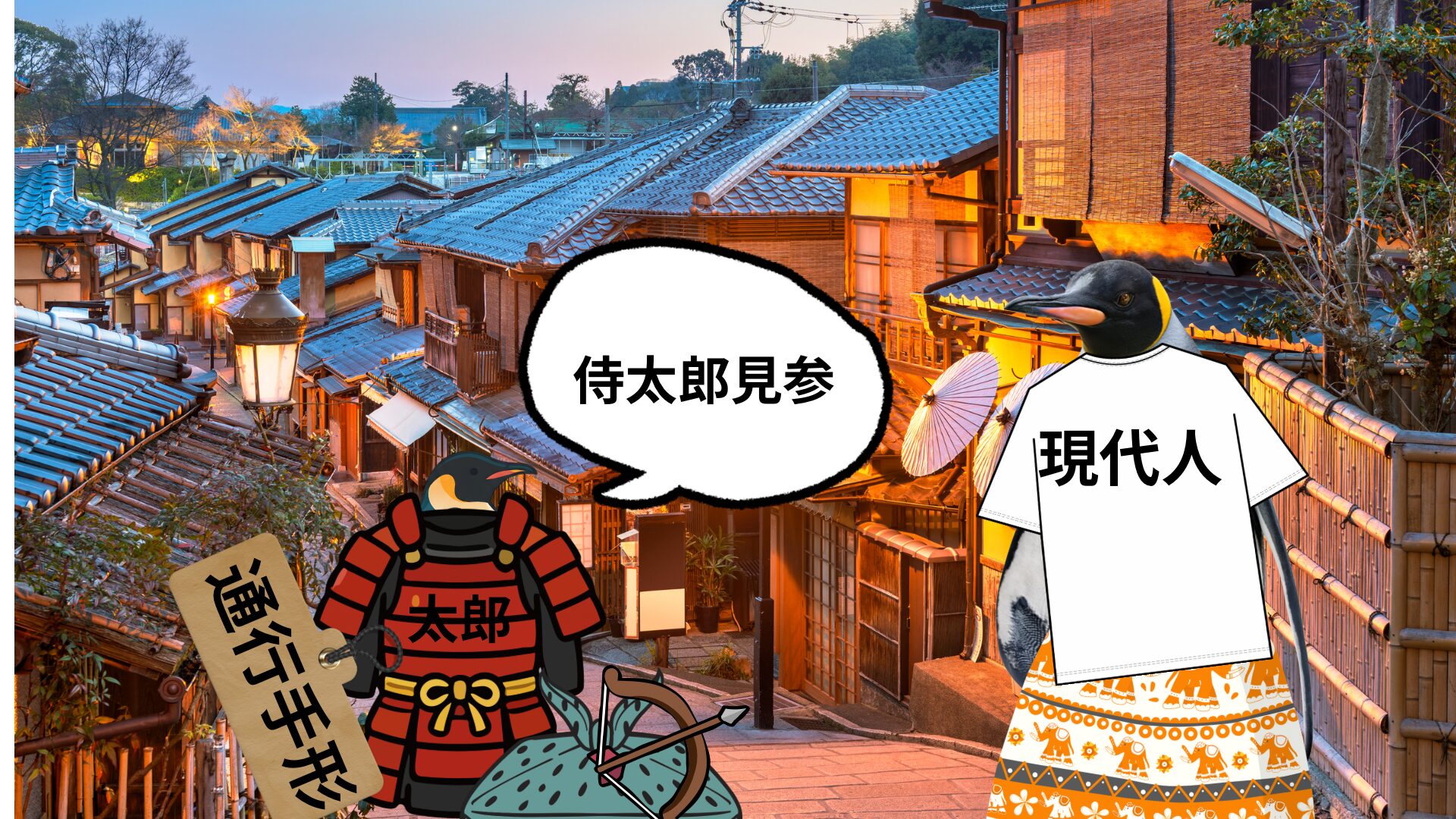
An unforgettable journey through traditional Japan… or has Taro accidentally traveled 400 years into the past?
1. Welcome to Ancient Japan!
After their adventures in Tokyo and Nagoya, Sho and Taro finally arrived in Kyoto.
As they walked through the narrow streets of Higashiyama, Taro could hardly believe his eyes.
Traditional wooden houses, stone-paved streets, beautiful temples…
“SHOOOOO! THIS IS IT!” Taro screamed.
“What is it?” Sho asked.
“THE REAL JAPAN! WE’VE FINALLY ARRIVED IN THE EDO PERIOD!”
Sho sighed.
“Taro, it’s 2026.”
“Really? Then why are all these buildings so old?”
“Because Kyoto preserves much of its traditional architecture.”
Taro suddenly grabbed a passing pedestrian.
“Excuse me, sir! Where can I meet Tokugawa Ieyasu?”
The man stared at him.
“……What?”
“Is he at home today? I would like to introduce myself!”
The man hurried away.
“TARO! Tokugawa Ieyasu died in 1616!”
Taro looked disappointed.
“Oh no! So I missed his appointment?”
“BY MORE THAN 400 YEARS!” Sho shouted.
2. Where Is the Checkpoint?
A few minutes later, Taro stopped walking.
“Sho! We have a serious problem!”
“What now?”
“We haven’t passed through a checkpoint!”
“A checkpoint?”
“Yes! I learned that travelers in old Japan needed permission to travel.”
Taro opened his enormous furoshiki, a traditional Japanese wrapping cloth.
Out came a piece of paper covered in handwritten Japanese characters.
“TA-DAAA! My travel permit!”
Sho examined it.
“What on earth is this?”
“My tsūkō tegata! I made it myself with a brush and ink!”
“Taro, we don’t use those anymore!”
“WHAT?! Then where is the sekisho?”
“A sekisho was a checkpoint used in historical Japan.”
“So how do they check travelers today?”
“We have modern transportation systems, Taro!”
Taro looked horrified.
“No checkpoints? No travel permits? Sho, Japan has become very careless!”
“YOU’RE THE ONE CARRYING A 400-YEAR-OLD DOCUMENT!”
3. A Samurai Meets a Maiko
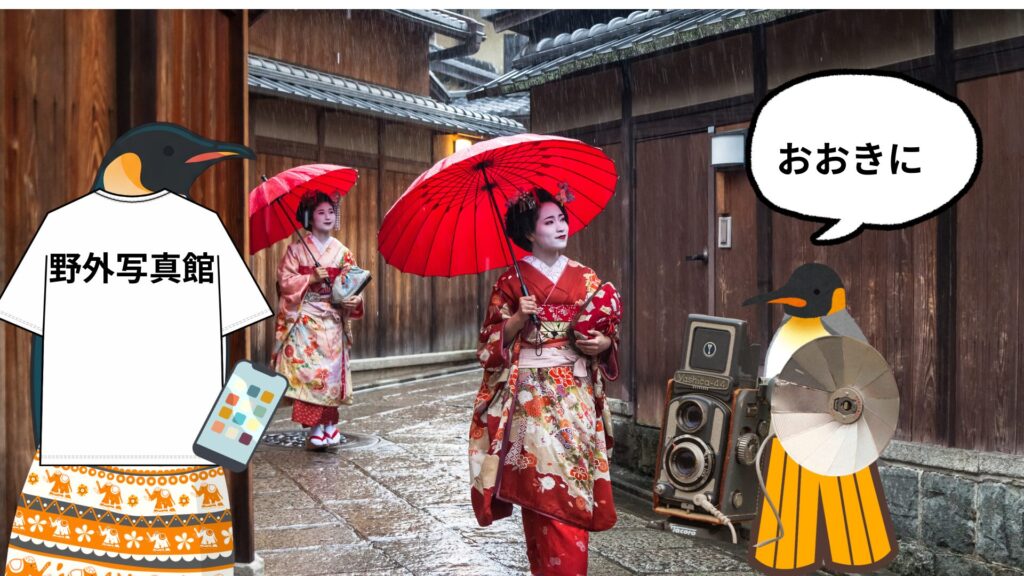
As they continued walking, Taro spotted a woman dressed in a beautiful traditional kimono.
“SHO! LOOK! A PRINCESS!”
“That’s a maiko, an apprentice geisha.”
“A real maiko?! Wait! I must dress properly!”
Before Sho could stop him, Taro opened his furoshiki again.
Out came a kimono, hakama trousers, a topknot wig, and a toy sword.
Five minutes later, Taro emerged dressed as a samurai.
“HOW DO I LOOK?”
“Like a penguin who escaped from a historical drama.”
“Excellent! Now I can meet the princess!”
“She’s not a princess!”
Taro proudly marched down the street.
“Greetings! I am Samurai Taro, a loyal servant of Lord Tokugawa!”
Several tourists stopped to take pictures.
Taro smiled.
“Sho! I’m becoming famous in Japan!”
“Yes. For all the wrong reasons.”
4. The Kiyomizu Stage Disaster!
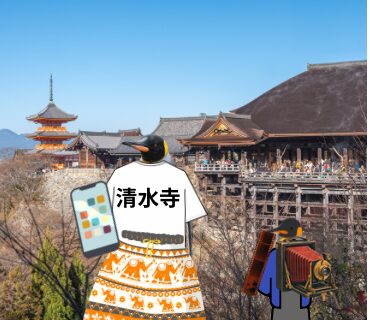
Their final destination was Kiyomizu-dera, one of Kyoto’s most famous temples.
Taro stood in front of its magnificent wooden stage.
“SHO! I KNOW THIS PLACE!”
“Really?”
“Yes! I saw it in a Japanese movie!”
Sho smiled.
“There’s a famous Japanese expression: Kiyomizu no butai kara tobioriru.”
“What does it mean?”
“Literally, ‘to jump off the stage of Kiyomizu.’ But it actually means making a big, courageous decision.”
Taro’s eyes began to sparkle.
“A BIG DECISION?!”
“Exactly.”
“I UNDERSTAND!”
Suddenly, Taro tightened his samurai belt and rushed toward the stage railing.
“WAIT! WHAT ARE YOU DOING?!” Sho yelled.
“I’M GOING TO BECOME A TRUE JAPANESE SAMURAI!”
“STOP!”
Sho grabbed Taro and pulled him safely away from the railing.
“IT’S AN IDIOM! YOU’RE NOT SUPPOSED TO ACTUALLY JUMP!”
Taro looked shocked.
“So… Japanese people don’t jump off this stage?”
“OF COURSE NOT!”
Taro slowly removed his topknot wig.
“Sho… Japanese is a very dangerous language.”
“NO! YOUR INTERPRETATION IS DANGEROUS!”
5. What Did Taro Learn?
On their way back, Taro looked thoughtfully at the streets of Kyoto.
“Sho, I think I finally understand Japan.”
“That’s good.”
“Japan is a wonderful country where ancient samurai traditions and modern life exist together.”
“Exactly!”
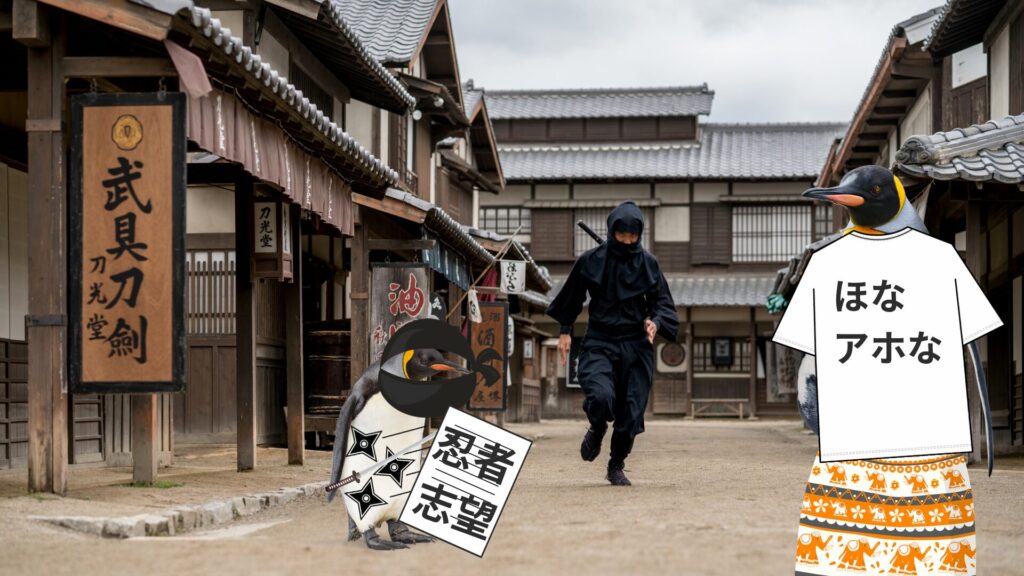
“And tomorrow, I want to meet a ninja!”
Sho stopped walking.
“……A ninja?”
“Yes! Do you know where their office is?”
“TAROOOOOO!!!”
To be continued… 🐧🤣
🇯🇵 Learn Japanese with Sho & Taro
1. 風呂敷 — Furoshiki
A traditional Japanese cloth used to wrap and carry objects.
Example: 風呂敷で包みます。
Furoshiki de tsutsumimasu.
“I wrap it in a furoshiki.”
2. 関所 — Sekisho
A historical checkpoint where travelers could be inspected. Checkpoints played an important role during the Edo period.
Example: 昔、ここに関所がありました。
Mukashi, koko ni sekisho ga arimashita.
“There used to be a checkpoint here.”
3. 舞妓 — Maiko
An apprentice geisha, particularly associated with Kyoto’s traditional entertainment culture.
Example: 京都で舞妓さんを見ました。
Kyōto de maiko-san o mimashita.
“I saw a maiko in Kyoto.”
4. 清水の舞台から飛び降りる
Kiyomizu no butai kara tobioriru
Literal meaning: To jump off the stage of Kiyomizu.
Actual meaning: To make a bold decision or take a major step despite uncertainty.
Example: 清水の舞台から飛び降りるつもりで買いました。
Kiyomizu no butai kara tobioriru tsumori de kaimashita.
“I took the plunge and bought it.”
Remember: This is a figurative expression. Never attempt to jump from the actual stage!
🏯 Kyoto Travel Tips
Kyoto is famous for its temples, shrines, traditional wooden architecture, and historic neighborhoods.
Three highlights from Taro’s adventure:
- Higashiyama: A picturesque district with traditional streets and historic buildings.
- Gion: One of Kyoto’s best-known traditional entertainment districts, associated with geiko and maiko.
- Kiyomizu-dera: A celebrated Buddhist temple known for its wooden stage and sweeping views of Kyoto.
Please respect local residents, follow photography restrictions, and never stop or chase maiko or geiko for pictures.
And remember: you don’t need a samurai costume, a travel permit, or an appointment with Tokugawa Ieyasu to visit Kyoto! 🤣
See you in the next adventure of Sho & Taro!