One foreign penguin. One freezing winter night. One traditional Japanese charcoal brazier. What could possibly go wrong?
- 1. Welcome to Nagoya — At Midnight?!
- 2. Taro’s Traditional Japanese Survival Equipment
- 3. Welcome to Japan’s Chocolate Wonderland
- 4. WHY? The Psychology Behind the Chocolate Queue
- 5. Japanese You Can Actually Use
- 6. The Great Chocolate Disaster
- Sho’s Final Travel Tip
- Next Episode — Kyoto: A Penguin from the Wrong Century!
1. Welcome to Nagoya — At Midnight?!
After surviving Tokyo’s automatic ticket gates, Sho and Taro finally arrived in Nagoya.
Their Shinkansen journey had been surprisingly peaceful.
Too peaceful.
At 11:58 p.m., Sho received a message.
Taro: “Boss Sho! I’m ready for my next Japanese cultural experience!”
Sho: “Wonderful! What are we doing tomorrow?”
Taro: “Tomorrow? I’m already here!”
Sho: “WHERE?!”
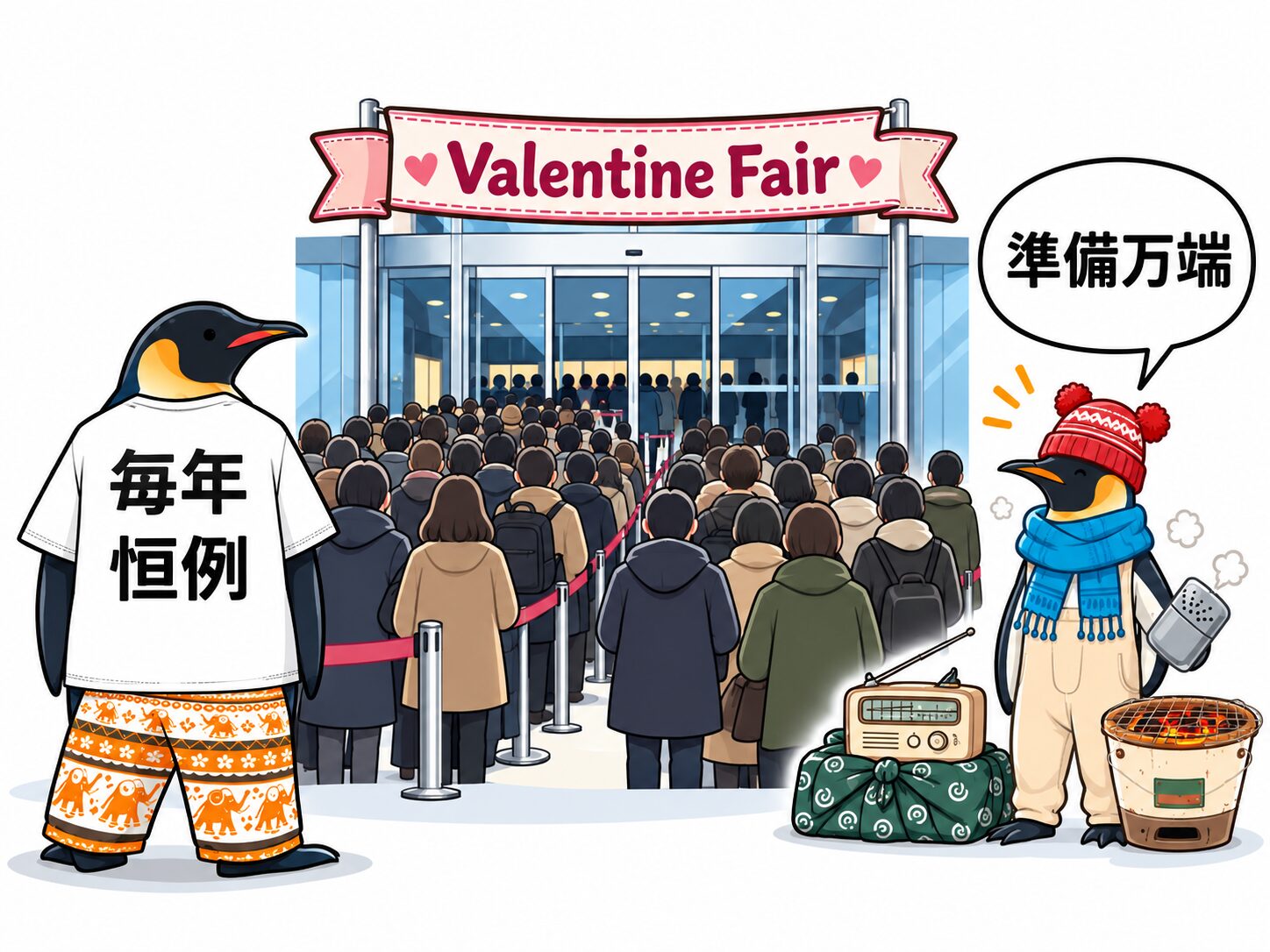
Taro: “Outside the department store! I’ve come to join the famous Japanese chocolate queue!”
Sho stared at his phone.
Sho: “TAROOOOOO!!! IT’S ALMOST MIDNIGHT!!”
And so began another completely unnecessary emergency.
2. Taro’s Traditional Japanese Survival Equipment
When Sho arrived, he found a small penguin dressed for what looked like a polar expedition.
Taro was wearing his usual red haori jacket and black traditional trousers.
But underneath them?
His father’s old-fashioned momohiki — traditional long underwear.
On his head were enormous fluffy earmuffs.
Beside him sat his beloved patterned furoshiki, stuffed with ancient equipment.
Sho looked inside.
A portable radio.
A black rotary telephone.
An old-fashioned oil-fueled pocket warmer.
And finally…
A hibachi, a traditional charcoal brazier.
Sho: “TARO! WHY DID YOU BRING A CHARCOAL BRAZIER?!”
Taro: “Because Japanese people are famous for their long queues!”
Sho: “THAT DOESN’T EXPLAIN THE HIBACHI!”
Taro: “My father taught me to prepare for winter.”
Sho: “And the telephone?”
Taro: “In case I need to call for help.”
Sho: “WHERE ARE YOU GOING TO PLUG IT IN?!”
Taro looked genuinely offended.
Taro: “Boss Sho, please respect traditional technology.”
Sho buried his face in his hands.
Sho: “And don’t even THINK about lighting that thing here!”
The hibachi remained unlit.
Taro was disappointed.
The people of Nagoya were considerably safer.
3. Welcome to Japan’s Chocolate Wonderland
So, what exactly had inspired Taro’s midnight adventure?
Every winter, Nagoya hosts a spectacular chocolate event called Amour du Chocolat at JR Nagoya Takashimaya, a department store directly connected to Nagoya Station.
It takes place in the run-up to Valentine’s Day.
The event brings together famous chocolate makers, special collaborations, beautifully packaged sweets, and limited-edition products.
And the crowds can be extraordinary.
In 2026, the event attracted more than 950,000 visitors and generated sales exceeding 5.6 billion yen, according to the organizer.
Yes.
Billion.
With a B.
This is not just a small chocolate sale.
It is a major shopping event.
Some visitors plan their purchases carefully. Others come to discover new flavors, meet celebrated pastry chefs, or buy something special for themselves.
And some people are prepared to wait a very long time.
Sho: “I’ve actually seen people near the front of these queues carrying things that looked like sleeping bags.”
Taro: “SLEEPING BAGS?!”
Sho: “Yes. I couldn’t tell when they had arrived, but they certainly looked prepared for a long wait.”
Taro’s eyes sparkled.
Taro: “Boss Sho! My father was right! I should have brought a futon!”
Sho: “NO MORE LUGGAGE!!”
4. WHY? The Psychology Behind the Chocolate Queue
Now comes an interesting question.
Why would someone spend hours waiting to buy chocolate?
After all, chocolate is available in supermarkets, convenience stores, and online shops.
Sho had a few ideas.
First: Scarcity.
Limited-edition products can feel more desirable precisely because they are difficult to obtain.
When something might sell out, people may feel an urge to buy it immediately.
Second: The experience.
For genuine chocolate enthusiasts, the event itself can be exciting. Discovering new flavors and meeting talented creators may be worth the wait.
Third: Social influence.
When hundreds of people are standing in a line, others may assume something extraordinary must be waiting at the end.
A long queue becomes a kind of advertisement.
But does that mean everybody should join?
Of course not.
Sho: “Taro, here’s something important. A popular product isn’t automatically the right product for you.”
Taro: “But everyone is lining up!”
Sho: “That’s exactly why you should think for yourself.”
For some people, waiting is part of the fun.
For others, spending several hours in a queue would be a terrible use of a holiday.
Neither person needs to make the same choice.
The important question is simple: Do you actually want the chocolate, or do you just want to follow the crowd?
Taro stood silently for a moment.
Then he nodded.
Taro: “I understand, Boss Sho.”
Sho smiled.
At last, his student had learned something.
Or so he thought.
5. Japanese You Can Actually Use
If you visit a popular attraction, restaurant, or special event in Japan, these expressions will come in handy.
① 最後尾はどこですか?
Saikōbi wa doko desu ka?
Where is the end of the line?
最後尾 (saikōbi) means the end of a queue.
At busy events, you may also see a sign reading 最後尾, showing where new arrivals should stand.
② 何時間待ちですか?
Nan-jikan machi desu ka?
How many hours is the wait?
A useful question before committing your precious holiday time to a queue.
③ 整理券は必要ですか?
Seiriken wa hitsuyō desu ka?
Do I need a numbered ticket?
整理券 (seiriken) is a ticket used to organize entry or purchases.
Some Japanese events use timed admission, advance reservations, or numbered tickets.
Travel tip: Admission procedures can change from year to year and between individual brands. Check the official event information before visiting. Never assume that overnight waiting is permitted.
Taro: “Boss Sho! I have memorized all three phrases!”
Sho: “Excellent!”
Taro: “But I have one more question.”
Sho: “What is it?”
Taro: “How do you say ‘Where can I park my hibachi?'”
Sho: “TAROOOOOO!!!”
6. The Great Chocolate Disaster
The next morning, Sho finally asked the question that had been bothering him all night.
Sho: “Taro, which chocolate are you hoping to buy?”
Taro: “Chocolate?”
Sho: “YES. CHOCOLATE. THE ENTIRE REASON WE’RE HERE!”
Taro looked confused.
Then he proudly adjusted his earmuffs.
Taro: “Boss Sho, I didn’t come here to buy chocolate.”
There was a long silence.
Sho: “…What?”
Taro: “I came to understand Japanese culture!”
Sho: “AND?!”
Taro: “Now I know how to stand in a Japanese queue!”
Sho closed his eyes.
He had guided international visitors through airports, train stations, and complicated ticket machines.
Nothing had prepared him for this.
Sho: “TARO! YOU TRAVELED ALL THE WAY TO NAGOYA TO PRACTICE WAITING?!”
Taro: “Yes! And next time, I’ll bring my father’s futon!”
Sho: “ABSOLUTELY NOT!!!”
🤣🤣🤣
Sho’s Final Travel Tip
Nagoya has much more to offer than chocolate.
Try local specialties, explore the city, and discover places that genuinely interest you.
If waiting for a special box of chocolates makes you happy, enjoy it.
But remember:
You don’t have to follow the crowd to enjoy Japan.
Sometimes, the best travel experiences begin when you choose your own path.
Preferably without carrying a charcoal brazier.
Next Episode — Kyoto: A Penguin from the Wrong Century!
After causing chaos in Nagoya, Taro is heading to Kyoto.
Ancient temples. Traditional streets. Beautiful Japanese culture.
Surely nothing can go wrong this time…
Sho: “Taro, why are you smiling like that?”
Taro: “Boss Sho! I think I have finally found the Japan I’ve been looking for!”
Sho: “Oh, no…”
To be continued!
Sho & Taro’s Crazy Japan Adventures — Episode #003
This story combines the author’s firsthand observations with fictional comedy. Taro’s midnight expedition and unusual equipment are imaginary. Always follow local rules and event staff instructions.