Four AIs. One prompt.
No detailed instructions.
No examples.
No second chances.
I simply give the same creative prompt to four different AI models and see what happens.
The participants are:
・ChatGPT
・Copilot
・Gemini
・Claude
The interesting part is not deciding which AI is “the best.”
What interests me is something much stranger:
When different AIs receive exactly the same vague prompt, why do they create completely different worlds?
This time, the challenge was simple.
“Imagine everyday life in Japan 100 years from now.
Create one image showing what you think it will look like.”
First up: ChatGPT.
I usually call it “Taimii.” 🤣
■ ChatGPT’s Japan 100 Years From Now
And this is what appeared.
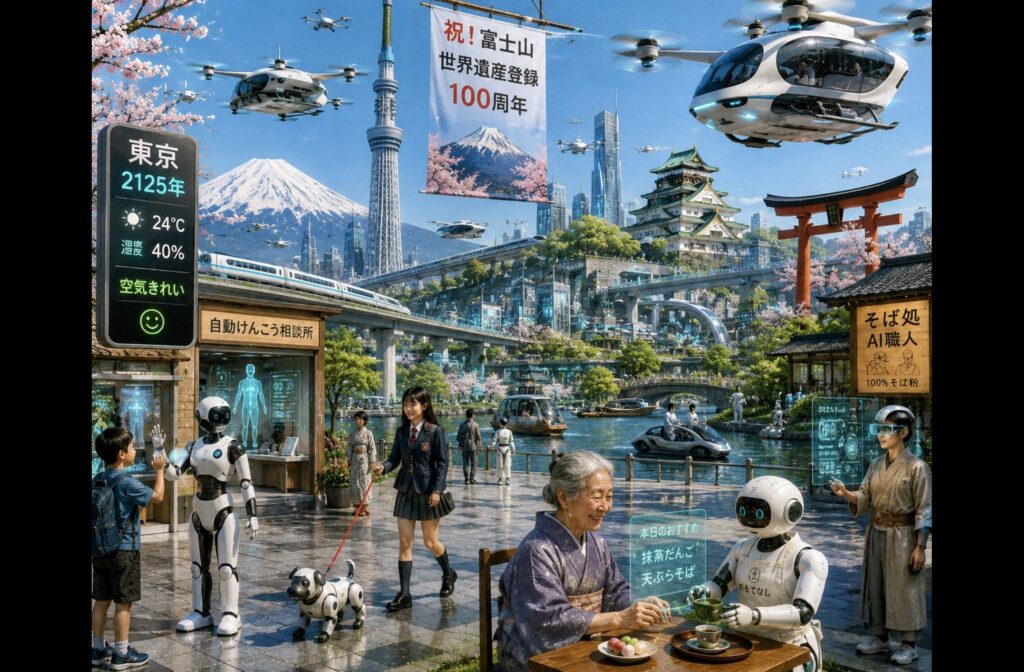
Apparently, this is Japan in 2125.
At first glance, it certainly looks futuristic.
Flying vehicles fill the sky.
Robots walk alongside humans.
Advanced transportation systems cross the city.
Digital displays have become part of everyday life.
But then I started looking more carefully.
Wait a minute.
There is Mt. Fuji.
There is Tokyo Skytree.
There is a traditional Japanese castle.
There is a huge torii gate.
There are cherry blossoms.
There are robots.
There is even an elderly woman calmly sitting at a table with a robot.
ChatGPT apparently decided that the safest way to imagine Japan 100 years from now was:
“KEEP EVERYTHING.” 🤣
■ The Future Changed. Japan Didn’t.
This is what makes the image interesting.
Technology has changed dramatically, but the basic visual identity of Japan has survived.
Old and new exist side by side.
A robot can sit with an elderly woman.
A futuristic aircraft can fly past Mt. Fuji.
A high-tech city can grow around a traditional castle.
Perhaps ChatGPT’s future is not about replacing the past.
It is about adding new technology without throwing the old world away.
That interpretation is actually quite interesting.
■ This Is Why I Started the Experiment
AI comparisons usually focus on things such as:
speed,
accuracy,
benchmarks,
reasoning,
coding,
or productivity.
Those comparisons are useful.
But I wanted to look at something different.
What happens when we stop giving AI practical jobs and simply let it create?
No complicated prompt engineering.
No attempt to force a particular answer.
Just one strange question and complete freedom.
That is when something interesting begins to appear.
Each AI interprets the same simple prompt in its own way.
■ The Image May Become More Interesting With Age
There is another reason I want to keep these experiments.
An article about the “latest AI” can become outdated very quickly.
But creative experiments work differently.
Imagine looking at this image in 2030.
Or 2035.
By then, AI image generation may have changed enormously.
The strange details, mistakes, visual habits and assumptions in today’s AI-generated images may become even more interesting.
In other words, these images are not only entertainment.
They may become tiny historical records of how AI imagined the world in 2026.
■ ChatGPT Has Finished the First Challenge
So this is ChatGPT’s answer to the first challenge.
A bright future filled with robots, flying vehicles, traditional Japanese scenery and everyday life.
Some details make sense.
Some are unexpected.
And some simply make me laugh. 🤣
But that is exactly why I started this experiment.
The other AIs have been given exactly the same prompt.
What will they create?
That will be revealed one by one.
The AI creative experiment has only just begun.