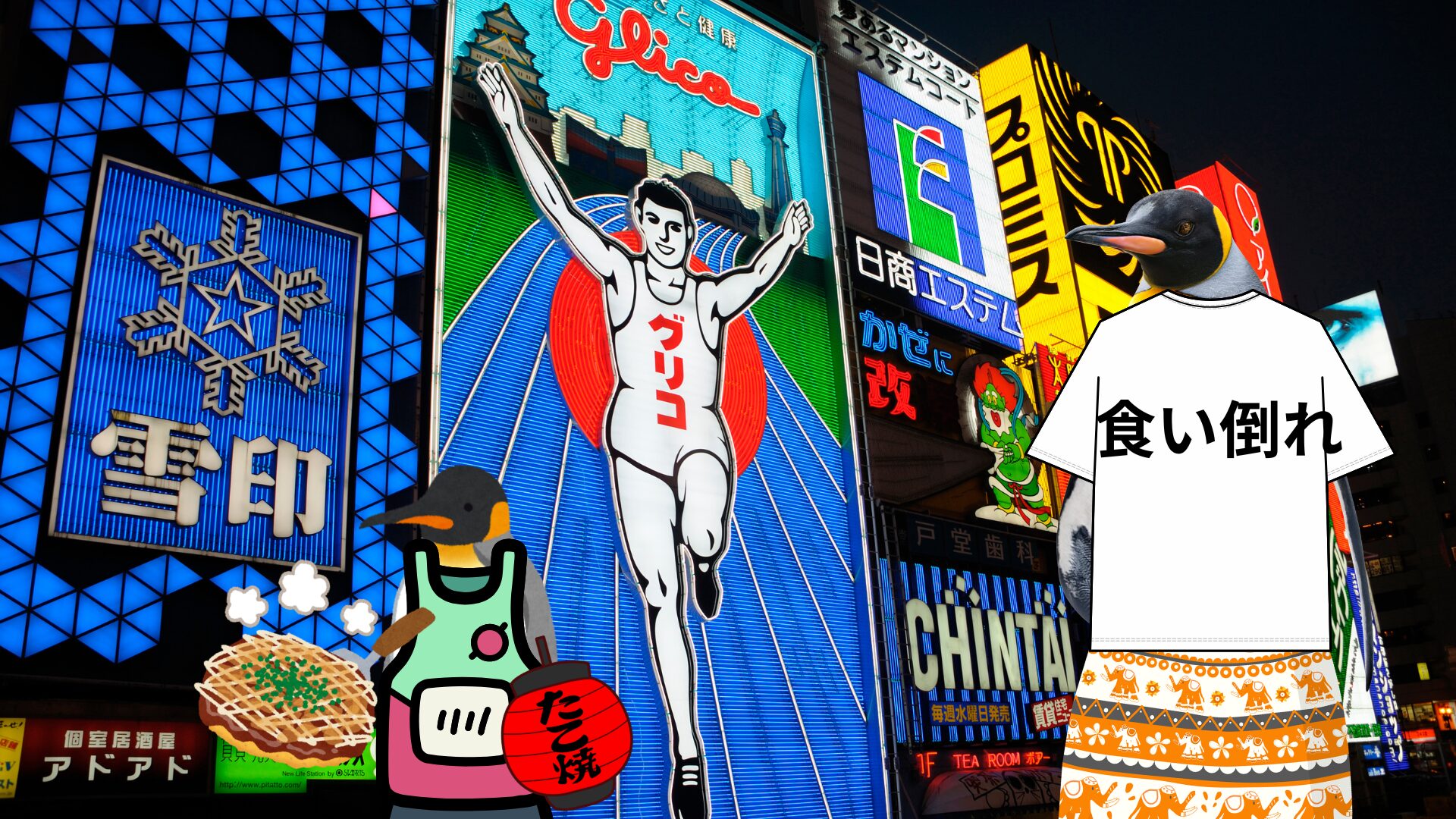
The final adventure of Season One: Japanese culture, Osaka street food, and one very confused penguin.
After surviving Kyoto’s samurai adventures, ninja job interviews, and the terrifying misunderstanding at Kiyomizu Temple, Taro was finally ready for a peaceful day.
Or so Sho hoped.
Their next destination was Osaka, a city famous for its delicious food, lively shopping streets, and colorful neon signs.
Unfortunately, Taro had already discovered a new Japanese expression.
And that was where the trouble began.
1. Welcome to Osaka — The City of Kuidaore!
As they walked through the busy streets of Dotonbori, Sho pointed toward the restaurants.
“Welcome to Osaka, Taro! This city is famous for kuidaore.”
Taro stopped walking.
“Kuidaore?”
“Yes. 食い倒れ.”
“What does that mean?”
“It describes spending so much money on delicious food that you practically go broke.”
Taro’s eyes widened.
“WHAT?!”
Sho sighed.
“Here we go again.”
“People become bankrupt because of food?!”
“It’s just a traditional expression!”
Taro looked around nervously.
“Then why are all these restaurants still open? This city is dangerous!”
“Taro, nobody is forcing you to eat!”
But Taro was already digging through his enormous traveling bag.
He pulled out a notebook and wrote:
OSAKA SURVIVAL RULE NO. 1: NEVER TRUST DELICIOUS FOOD.
Sho stared at him.
“We’ve been here for three minutes.”
2. The Takoyaki Emergency 🐙
A wonderful smell drifted through the shopping street.
Taro followed it immediately.
“SHO! What are those little round things?”
“Takoyaki. They’re one of Osaka’s most famous foods.”
“What’s inside?”
“Octopus.”
Taro froze.
“AN OCTOPUS?!”
“Yes. Small pieces of octopus.”
Taro leaned closer to the cooking pan.
“How did they fit an entire octopus inside such a tiny ball?”
“Not an entire octopus!”
“Poor octopus! It must be very uncomfortable!”
“TARO!”
The shopkeeper smiled.
“いらっしゃいませ!”
Taro straightened his back.
“Hello! I’m here for a job interview!”
Sho nearly dropped his phone.
“A WHAT?!”
“I’ve decided to become a takoyaki chef!”
“Since when?!”
“Since ten seconds ago!”
Taro proudly took out the same résumé he had used for his ninja interview in Kyoto.
He crossed out Ninja and wrote:
TAKOYAKI MASTER — AVAILABLE IMMEDIATELY.
Sho covered his face.
“Please tell me you didn’t put ‘professional samurai’ under work experience.”
“Of course I did!”
3. The Most Dangerous Job Interview in Osaka
The shopkeeper, amused by the strange penguin, allowed Taro to watch how takoyaki was prepared.
“Look, Taro,” Sho explained. “The cook turns the takoyaki carefully with a small pick.”
Taro watched with complete seriousness.
Then he raised his wing.
“Excuse me! Is there an entrance examination?”
“An examination?” Sho repeated.
“Yes! I brought my own equipment!”
From his bag, Taro produced his old samurai helmet.
Sho shouted.
“WHY DO YOU STILL HAVE THAT?!”
“Safety first!”
“Taro, you’re cooking takoyaki, not fighting a war!”
Taro nodded thoughtfully.
“You’re right. I should also bring a shield.”
“NO!”
A few minutes later, the shopkeeper handed them freshly cooked takoyaki.
Taro took one bite.
“AAAAAAAH!”
“What’s wrong?!”
“IT’S HOT!”
“Of course it’s hot! It was just cooked!”
Taro quickly drank some water.
Then he smiled.
“Sho, I understand now.”
“Understand what?”
“THIS is why Osaka is called the city of kuidaore!”
Sho stared at him.
“No. That’s not why.”
“People eat delicious food and collapse from the heat!”
“THAT’S NOT WHAT IT MEANS!”
Taro opened his notebook again.
OSAKA SURVIVAL RULE NO. 2: TAKOYAKI IS A VOLCANIC WEAPON.
4. Maido! Ookini! — Osaka’s Mysterious Language
Later, the two penguins explored a lively shopping street.
A friendly shopkeeper greeted them.
“まいど!”
Taro looked confused.
“My door?”
Sho laughed.
“No, Taro. Maido is a traditional Kansai-style greeting often heard in shops.”
“Oh! So it’s not about doors?”
“No.”
After buying a small souvenir, they heard another expression.
“おおきに!”
Taro gasped.
“BIG?!”
“What?”
“Did he say I’m big?”
Sho shook his head.
“No! Ookini means ‘thank you’ in Kansai dialect.”
Taro smiled proudly.
“Wonderful! I’m learning Japanese so quickly!”
Sho looked exhausted.
“You’re learning the wrong meaning first every single time.”
Taro opened his notebook.
MAIDO = NOT MY DOOR
OOKINI = THANK YOU, NOT BIG
Then he added one more sentence:
I AM NOW FLUENT IN OSAKA JAPANESE.
Sho whispered, “We’re in trouble.”
5. The Glico Challenge 🏃
That evening, the neon lights of Dotonbori filled the streets with color.
Taro suddenly pointed at a giant illuminated sign.
“SHO! LOOK!”
“What is it now?”
“That man is running!”
“Yes. That’s the famous Glico running man.”
“Why is he running?”
“It’s a famous advertising symbol.”
Taro studied the sign carefully.
Then he nodded.
“I understand!”
Sho became suspicious.
“What do you understand?”
“People in Osaka must run after eating to avoid kuidaore!”
“No, Taro.”
“It makes perfect sense!”
“No, it doesn’t.”
“First, they eat takoyaki. Then they run!”
“Taro—”
“Then they eat okonomiyaki. Then they run again!”
“STOP!”
But Taro had already raised both wings, copying the famous running pose.
“SHO! TAKE MY PICTURE!”
Sho reluctantly lifted his phone.
Taro shouted:
“OSAKA SURVIVAL RULE NO. 3!”
Sho closed his eyes.
“Please don’t.”
“RUN BEFORE THE TAKOYAKI EXPLODES!”
“TAROOOOOO!”
6. The Final Job Interview
As they prepared to leave Osaka, Sho finally asked the question he had been avoiding.
“Taro, did you enjoy your trip around Japan?”
“Absolutely! I learned so much!”
Sho smiled.
“That’s wonderful.”
“I learned about samurai, ninjas, Japanese shopping streets, traditional food, and Osaka dialect!”
“Good!”
“And I discovered my true purpose in life!”
Sho hesitated.
“Your true purpose?”
“YES!”
Taro proudly unfolded a new résumé.
At the top, in enormous letters, he had written:
JAPAN CULTURAL EXPERT
Sho blinked.
“You’re applying for another job?”
“Of course!”
“Where?”
“Everywhere in Japan!”
“EVERYWHERE?!”
“I’ve decided to travel across all 47 prefectures until I find my dream job!”
Sho stared silently at his friend.
“Taro, you haven’t passed a single job interview.”
Taro smiled.
“That’s not true!”
“What?!”
“The ninja interviewer was so impressed that he couldn’t speak!”
“He told you to leave!”
“And the takoyaki shopkeeper laughed throughout my interview!”
“Because you brought a samurai helmet!”
Taro folded his résumé and placed it carefully inside his bag.
“Don’t worry, Sho. I’m getting better every day!”
Sho sighed.
“Where are we going next?”
Taro grinned.
“That’s a surprise!”
“Why do I have a terrible feeling about this?”
“Because the adventure is just beginning!”
Sho looked at the enormous bag filled with costumes, old cameras, strange documents, and completely unnecessary equipment.
Then he whispered:
“Japan is not ready for this penguin.”
THE END — SEASON ONE
But Taro’s nationwide job hunt is only beginning! 🐧💼
Learn Japanese with Sho & Taro 🇯🇵
1. 食い倒れ(くいだおれ / Kuidaore)
Meaning: Spending so much money enjoying food that you go broke.
Osaka is famous for its rich food culture, and kuidaore is a playful expression closely associated with the city.
It does not mean that eating takoyaki will literally make you collapse!
2. たこ焼き(Takoyaki)
Meaning: A popular Japanese food made from small balls of batter containing pieces of octopus.
Useful phrase:
たこ焼きをください。
Takoyaki o kudasai.
“Takoyaki, please.”
3. まいど(Maido)
Meaning: A traditional Kansai-style greeting commonly associated with shopkeepers and business interactions.
It does not mean “my door”!
4. おおきに(Ookini)
Meaning: “Thank you” in Kansai dialect.
Standard Japanese:
ありがとう。
Arigatou.
Kansai-style:
おおきに。
Ookini.
5. いくらですか?(Ikura desu ka?)
Meaning: “How much is it?”
A very useful expression when shopping in Japan.
6. おすすめは何ですか?(Osusume wa nan desu ka?)
Meaning: “What do you recommend?”
Try this when visiting a restaurant or food stall.
7. 履歴書(りれきしょ / Rirekisho)
Meaning: Résumé or CV.
Taro carries one everywhere, although his career history is becoming increasingly difficult to explain.
8. 面接(めんせつ / Mensetsu)
Meaning: Job interview.
Useful phrase:
面接を受けます。
Mensetsu o ukemasu.
“I’m going to attend a job interview.”
Want to learn Japanese while having fun? Explore our Japanese learning materials on Payhip and discover the language and culture behind everyday life in Japan!
A Final Message from Sho & Taro
Learning Japanese isn’t only about memorizing vocabulary.
It’s also about discovering the culture, humor, regional expressions, and everyday customs behind the language.
Sometimes, taking an expression too literally can lead to a very strange adventure.
Especially if your name is Taro.
Thank you for joining Sho & Taro on their first journey across Japan!
And remember: Osaka’s food is delicious, but you don’t need a samurai helmet to eat takoyaki! 🤣
See you in the next adventure of Sho & Taro!