Sho & Taro’s Crazy Japan Adventures
In Japan, even buying chocolate can become an extraordinary adventure. Especially if you’re Taro.
Taro had traveled all the way from Malaysia to discover Japanese culture.
He wanted to experience authentic Japanese traditions, understand the local way of life, and become a respectable international traveler.
Unfortunately, he had one rather unusual idea about Japan.
He believed that standing in line was a traditional Japanese art form.
And he was determined to master it.
1. A Very Serious Cultural Mission
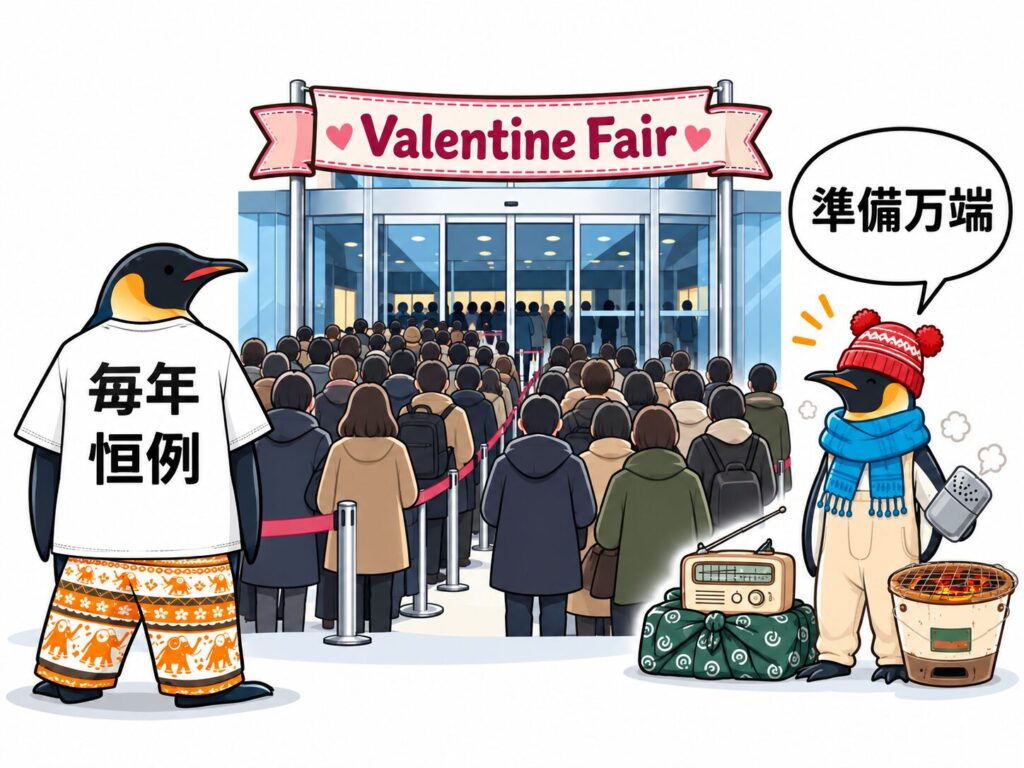 It was a cold February morning in Nagoya.
Outside a department store, a long line of people was waiting for a popular Valentine’s chocolate event.
Some were hoping to buy limited-edition chocolates. Others were looking for special gifts or treats for themselves.
And then there was Taro.
Wearing his father’s old-fashioned long underwear, a red knitted hat, and a thick blue scarf, he stood proudly beside an enormous collection of luggage.
He had brought a vintage radio, a bundle wrapped in traditional Japanese cloth, and even a small charcoal stove.
Sho stared at him in disbelief.
Sho: “Taro! What on earth are you doing here?”
Taro: “I’m studying Japanese culture!”
Sho: “By standing outside a department store?”
Taro: “Exactly! I’ve been here all night!”
Sho looked at the charcoal stove.
Sho: “And why did you bring THAT?”
Taro: “I’m fully prepared. I thought Japanese people loved waiting in line!”
Sho: “You’re buying chocolate, not preparing for a survival expedition!”
Taro looked terribly disappointed.
He had worked so hard to become Japanese.
And the store hadn’t even opened yet.
2. When Waiting Becomes an Event
Japan has a fascinating relationship with queues.
Popular restaurants attract long lines. Limited-edition products sell out quickly. Department stores organize seasonal events that draw enthusiastic shoppers.
Valentine’s chocolate fairs are a particularly interesting example.
For many shoppers, buying chocolate is no longer simply about choosing a present.
It can also be about discovering exclusive products, enjoying beautifully designed packaging, or experiencing a seasonal event.
Some people even look forward to the shopping experience itself.
But this raises an interesting question.
When does waiting become part of the entertainment?
And when does it simply become a waste of time?
3. Taro Discovers the Japanese Queue
After waiting for hours, Taro finally approached the entrance.
He looked extremely proud.
Taro: “Sho! I think I’ve finally mastered Japanese culture!”
Sho: “Really? What have you learned?”
Taro: “Patience. Discipline. Standing perfectly still.”
Sho: “Anything else?”
Taro: “Yes! Never leave your place in the queue!”
Sho sighed.
Sho: “Taro, that’s not the whole of Japanese culture.”
Taro: “What? Then why is everyone waiting?”
Sho: “Because they want chocolate.”
Taro froze.
Taro: “Chocolate?”
Sho: “Yes. Chocolate.”
Taro: “You mean I’ve been standing here all night for something I could eat?”
Sho: “That’s generally how chocolate works.”
Taro quietly adjusted his knitted hat.
His cultural mission had taken an unexpected turn.
4. Why Are Long Queues So Attractive?
Of course, not every Japanese person enjoys standing in line.
Many people dislike crowds and avoid popular attractions altogether.
Still, queues can become surprisingly powerful marketing tools.
A long line creates visibility.
When people see others waiting, they may assume that something valuable or special is available.
Scarcity can increase the attraction.
Limited editions, seasonal products, and exclusive events can create a sense of urgency.
And sometimes, waiting itself becomes part of the story.
People may remember the experience of finally buying a sought-after item after hours of anticipation.
But there is another side to this culture.
A long queue does not automatically mean that a product is better.
Popularity and quality are not always the same thing.
And time has value, too.
Spending two hours waiting for something may be enjoyable for one person and completely pointless for another.
Neither preference needs to be universal.
5. The Price of Following Everyone Else
Personally, I have never understood the attraction of standing in a long queue simply because something is popular.
If a restaurant has an enormous line, I would rather find another place.
If a product requires hours of waiting, I usually lose interest.
And if everyone rushes toward the same destination, I often feel more curious about the places they are ignoring.
Travel has taught me that some of the most memorable experiences happen away from the crowds.
A quiet café.
A small family-run restaurant.
A street that tourists rarely visit.
Or a conversation with someone who has no interest in following the latest trend.
For me, freedom means being able to decide what is worth my time.
There is nothing wrong with enjoying a popular event.
But there is also nothing wrong with walking away.
The important thing is knowing why you are there.
Are you genuinely interested?
Or are you simply following everyone else?
6. Taro’s Final Discovery
Eventually, the department store opened.
Sho turned toward Taro.
Sho: “Well, are you ready to buy some chocolate?”
Taro hesitated.
Taro: “Actually, Sho…”
Sho: “What now?”
Taro: “Is there another queue nearby?”
Sho: “WHY?”
Taro: “I think I need more practice!”
Sho stared at him.
The vintage radio continued playing.
The charcoal stove sat beside the luggage.
And Taro, wearing his father’s old-fashioned underwear, was already searching for his next cultural adventure.
Some lessons take longer than others.
Especially when your student is Taro.
A Final Thought
Experiencing another culture is not about blindly copying everything people do.
It is about observing, questioning, and discovering what those customs mean.
Sometimes we learn through explanations.
Sometimes we learn through experience.
And sometimes, like Taro, we learn by spending an entire night waiting for chocolate.
The best travelers don’t simply follow the crowd. They learn to think for themselves.
Explore More of Japan with Sho & Taro
Curious about the Japan that ordinary travel guides don’t always explain?
Discover everyday surprises, cultural misunderstandings, and unexpected experiences in:
First Time in Japan — What Guidebooks Don’t Tell You: Nagoya
An English-language Kindle travel book by Yume.
From everyday discoveries to unusual Japanese customs, there’s always more to explore beyond the familiar tourist attractions.